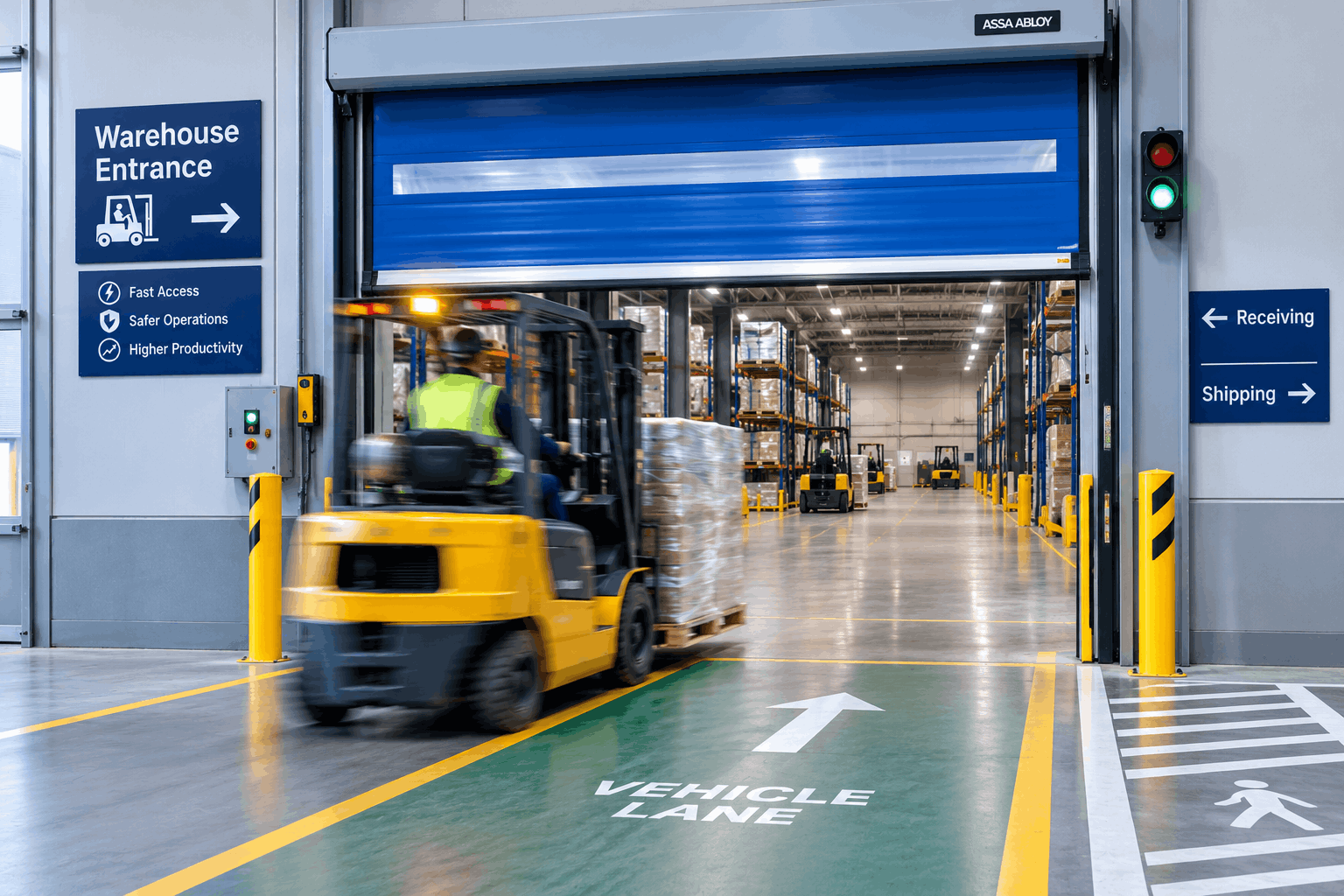
Industrial door opening speed matters most when people, forklifts, and vehicles repeatedly move through the same entrance. A slow or poorly coordinated door can create unnecessary waiting, while an appropriately configured high-speed system can help keep traffic moving between production areas, warehouses, loading zones, and exterior access points.
However, speed should not be viewed as an isolated specification. The useful performance of an industrial entrance depends on the complete operating cycle, including detection, opening, passage, safety controls, and closing.
What Does Industrial Door Opening Speed Mean?
Industrial door opening speed describes how quickly a door moves from its closed position toward a fully open position. It is normally expressed as a distance per unit of time, but the practical effect depends on the size and design of the opening.
For a busy facility, the more useful question is often:
How quickly can the entrance provide safe, reliable clearance for the next vehicle or worker?
A fast door can reduce the period during which traffic is waiting for access. Yet the door must still provide enough time and space for forklifts, loads, pedestrians, and other equipment to pass safely.
Why Speed Matters at Busy Entrances
Industrial entrances can become repeated points of interruption. A forklift approaching a closed doorway may need to stop, wait for the door to open, pass through, and wait again if another door or access point follows.
When the same process occurs throughout a working shift, entrance performance becomes part of the overall traffic pattern.
Higher operating speed can be useful where:
- Forklifts pass through frequently
- Vehicles move between production zones
- Loading and unloading activity is continuous
- Internal warehouse traffic is high
- Temperature-controlled areas need limited door-open time
- Automated vehicles use designated routes
The purpose is not simply to make the door move faster. It is to reduce unnecessary interruption while maintaining controlled and safe access.
Opening Speed Is Only One Part of the Cycle
A door’s opening speed does not tell the entire story.
Consider a simplified access cycle:
- A vehicle approaches the entrance.
- A sensor or control system detects the vehicle.
- The door receives an opening command.
- The door moves to the required position.
- The vehicle passes through.
- The system confirms that the passage is clear.
- The door closes.
If detection occurs too late, a fast door may still leave the vehicle waiting. Similarly, if the door remains open unnecessarily after the vehicle has passed, the overall system may not be operating as efficiently as intended.
This is why door speed should be evaluated together with sensors, controls, traffic patterns, and safety equipment.
Forklift Traffic Makes Access Performance Important
Forklifts often carry loads that require predictable clearance. Operators may need to slow down or stop before an entrance, particularly where visibility is limited or the door depends on manual activation.
Automatic detection can change this process. Depending on the installation, radar, induction loops, photoelectric sensors, or other control methods can signal that a vehicle is approaching.
When correctly configured, the system can prepare the entrance for the vehicle instead of requiring the operator to stop and activate the door manually.
For facilities evaluating options for repeated vehicle movement, rapid industrial access doors can be considered as part of a broader review of high-speed industrial entrance solutions.
Speed Can Support Environmental Separation
Industrial doors can also separate areas with different environmental conditions.
For example, a warehouse may need to limit unnecessary air exchange between an interior storage area and an exterior loading zone. A manufacturing facility may want to maintain separation between different production environments.
A faster opening and closing cycle can reduce the time an entrance remains open, but the actual result depends on the complete door design. Seals, panel or curtain construction, control settings, and installation conditions also influence environmental separation.
Therefore, facilities concerned with temperature control, dust, or air movement should evaluate the entire door system rather than focusing on speed alone.
High-Cycle Facilities Need More Than Fast Movement
Frequent operation places demands on the complete door assembly.
A door used repeatedly throughout the day needs a configuration appropriate for its expected operating frequency. Drive components, controls, sensors, mechanical parts, and safety equipment all need to work together reliably.
This is especially relevant in:
- Distribution centers
- Manufacturing facilities
- Automotive plants
- Logistics warehouses
- Loading areas
- High-traffic industrial buildings
Before selecting a system, facility managers should discuss expected operating cycles with the manufacturer or supplier rather than assuming that every high-speed door is designed for the same workload.
Safety Must Remain Part of the Speed Discussion
A faster door should never mean uncontrolled movement.
Industrial entrances may use photoelectric sensors, light curtains, safety edges, emergency controls, warning systems, and other protective features. These systems help account for vehicles, workers, loads, and obstacles around the opening.
Detection also needs to be positioned appropriately for the traffic pattern. A sensor that activates too late may reduce the practical benefit of a fast door, while poorly coordinated closing can create unnecessary safety concerns.
The objective is controlled speed: fast enough to support the operation, but integrated with the safety requirements of the facility.
How to Evaluate Door Speed for Your Facility
Instead of selecting a door solely because it has a particular opening-speed specification, start with the site’s actual traffic.
Record:
- Approximate vehicle traffic frequency
- Types of vehicles using the entrance
- Opening dimensions
- Expected operating cycles
- Indoor or outdoor location
- Temperature or environmental requirements
- Available installation space
- Detection and automation requirements
- Safety equipment requirements
Then consider how long vehicles currently wait and what causes those delays.
If the main problem is manual activation, automation may provide more value than simply increasing door speed. If the existing door itself creates repeated delays, a high-speed configuration may be worth investigating.
When Is a High-Speed Industrial Door Worth Considering?
A high-speed industrial door can be worth evaluating when an entrance experiences frequent traffic and repeated opening and closing. It may be particularly relevant when vehicle movement, environmental separation, and operational efficiency all matter.
The correct solution depends on the facility. A low-traffic storage room does not necessarily have the same requirements as a distribution center or manufacturing entrance.
For that reason, door speed should be treated as one part of a broader specification that includes construction, cycle frequency, controls, safety, environmental conditions, and installation requirements.
Ultimately, the value of a fast industrial door comes from how well its operating cycle fits the facility. When opening speed, detection, safety, and traffic movement are coordinated, the entrance can become a more predictable part of the industrial workflow rather than a recurring source of unnecessary waiting.