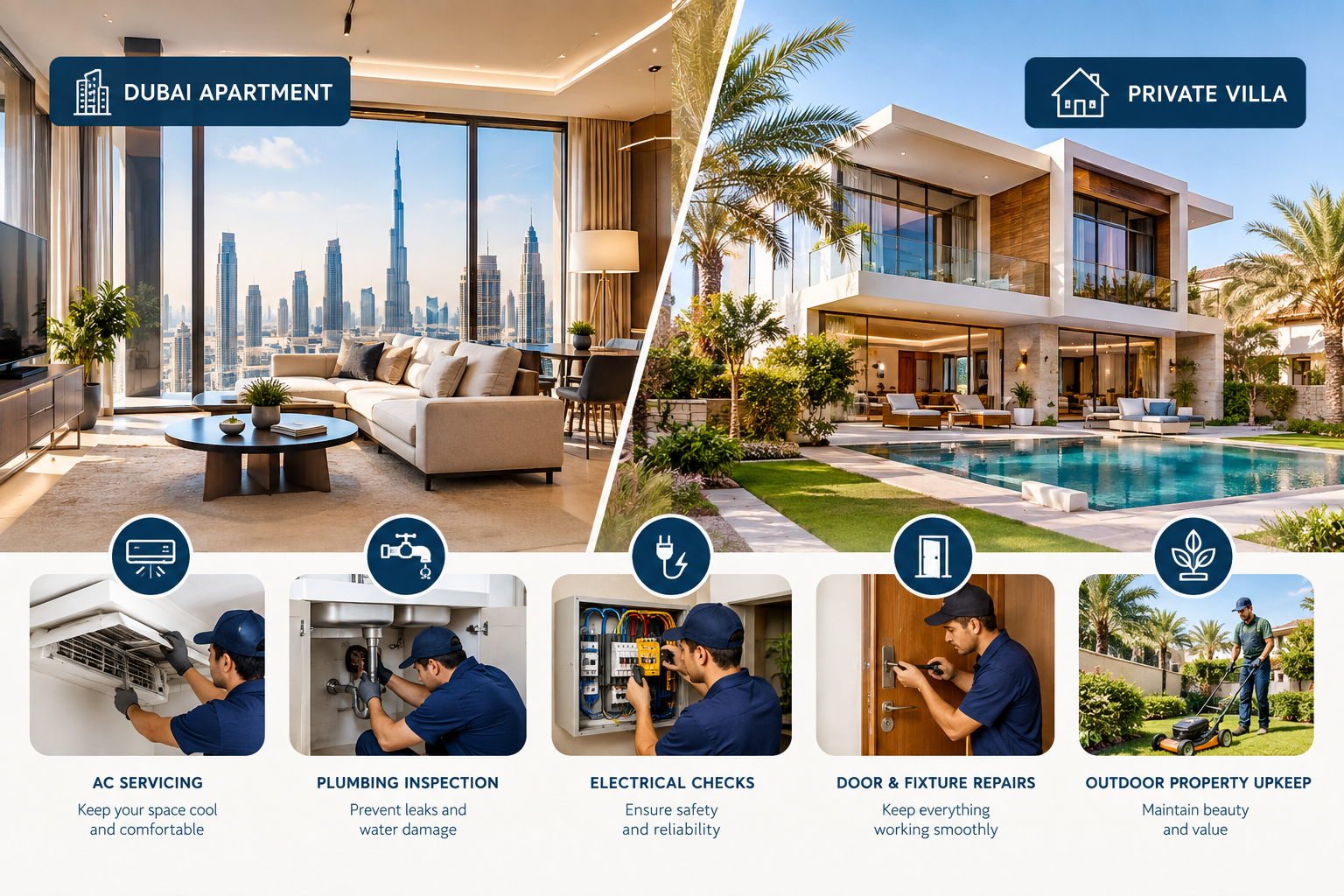
Apartment vs villa maintenance in Dubai differs mainly because villas usually place more individual systems, exterior areas, and property components under the resident’s direct care. Apartments often share major building infrastructure and common areas, but the individual unit still needs regular attention to air conditioning, plumbing fixtures, electrical components, appliances, doors, and interior finishes.
The exact responsibilities depend on the property and building arrangements. However, understanding the typical differences can help residents create a practical maintenance checklist and recognize when professional help may be needed.
Why Property Type Changes the Maintenance Checklist
An apartment is part of a larger building. Systems such as elevators, corridors, shared facilities, exterior structures, and some central services may fall under building or facilities management rather than the individual resident.
A villa is usually more independent. Depending on the property, the occupant or owner may need to consider exterior doors, outdoor fixtures, additional AC equipment, boundary areas, drainage points, and other components that would normally be managed collectively in an apartment building.
Therefore, villa maintenance is not simply apartment maintenance on a larger scale. The scope of responsibility can be different.
Apartment vs Villa Maintenance in Dubai: Main Areas to Compare
Both property types contain many of the same essential systems. The difference often lies in how much equipment exists, where it is located, and who is responsible for maintaining it.
Air Conditioning
Air conditioning deserves regular attention in both apartments and villas.
Residents should watch for changes such as weak airflow, reduced cooling, unusual noises, water around indoor equipment, or inconsistent temperatures. Accessible filters should be maintained according to the system’s requirements.
In an apartment, some parts of the cooling infrastructure may relate to a larger building system, depending on the property. As a result, residents should know which AC components fall within their unit and which concerns should be reported to building management.
A villa may have multiple independent units or zones. That can create more equipment to monitor and a larger servicing checklist.
The key is to understand your particular cooling setup rather than assuming every Dubai property uses the same system.
Plumbing Needs Can Differ by Property
Inside both apartments and villas, residents should pay attention to taps, toilets, sinks, showers, visible pipe connections, water heaters, and drainage.
Signs worth investigating include persistent dripping, unexplained moisture, slow drainage, unusual water pressure, staining, or recurring leaks.
In an apartment, it is especially important to determine whether a water problem originates inside the unit or may involve shared building infrastructure. A leak can sometimes affect neighboring units, making prompt reporting important.
Villas can have a broader plumbing footprint. Depending on the property, there may be additional bathrooms, outdoor taps, utility areas, external drainage points, or other water-related components to monitor.
If the source of a leak is uncertain, avoid assuming that the visible water marks the exact location of the fault. A plumber may need to trace the source.
Electrical Checks Apply to Both Homes
Whether you live in an apartment or villa, damaged electrical components and recurring faults deserve appropriate attention.
Residents can watch for problems involving switches, sockets, lighting, circuit breakers, and other accessible components. Repeated breaker trips, visible damage, unusual heat, burning smells, or recurring loss of power should not be treated as routine cosmetic defects.
Technical electrical work should be handled by an appropriately qualified professional.
Villa owners may have additional electrical considerations because the property can include more lighting, exterior fixtures, gates, outdoor equipment, or other independently maintained systems.
Apartment residents, meanwhile, may need to distinguish between an internal unit fault and a wider building issue before arranging repairs.
Villas Usually Have More Exterior Maintenance
Outdoor responsibility is one of the clearest differences between apartments and villas.
A typical apartment resident generally does not maintain the building facade, common entrance, shared corridors, or communal landscaping. Those areas are usually managed at building or community level.
A villa may include private exterior areas that need periodic inspection.
Depending on the property, these can include:
- Gates and exterior doors
- Outdoor lighting
- Boundary fixtures
- Exterior sealants
- Drainage points
- Patios or paved areas
- Outdoor taps
- Private garden-related fixtures
Exposure to heat, dust, moisture, and everyday use can affect exterior components differently from indoor fixtures. Adding them to a maintenance checklist makes them less likely to be overlooked.
Doors, Cabinets, and Interior Fixtures Need Routine Attention
Minor defects can occur in either property type.
Cabinet hinges loosen, doors stop closing smoothly, handles become unstable, sealant deteriorates, and wall finishes become damaged. Individually, these issues may not justify an urgent visit. Together, however, they can create a substantial maintenance list.
Apartment residents can often group several small interior jobs into one handyman visit.
The same strategy works in villas, although the list may extend to more rooms and exterior fixtures. Separating minor handyman tasks from plumbing, electrical, or AC problems also makes it easier to match each job with an appropriate professional.
Who Is Responsible for a Repair?
Before arranging work in an apartment, check whether the issue falls within the resident’s responsibility or the building’s maintenance structure.
For example, an internal fitting may clearly belong to the unit, while a fault involving a shared system may need to be reported to facilities management.
Tenants should also understand which repairs they are expected to report to the landlord or property manager before authorizing work.
Villa arrangements can vary as well, particularly in rented properties or managed communities.
When in doubt, check the tenancy terms, property-management procedures, or other applicable arrangements before approving substantial work.
When Should You Arrange Professional Property Maintenance?
Not every maintenance observation requires immediate repair. However, active faults, worsening defects, or technical problems should not simply remain on a checklist indefinitely.
Professional attention may be appropriate when:
- An AC unit no longer cools normally
- Water is actively leaking
- A drain repeatedly blocks
- An electrical fault keeps returning
- A fixture becomes unsafe or unstable
- A door or window no longer operates correctly
- Several unrelated maintenance jobs have accumulated
When a property develops issues across different categories, using property maintenance in Dubai can help residents connect their repair needs with suitable service professionals. A multi-category marketplace such as Repairoo is particularly relevant when the maintenance list spans areas such as AC, plumbing, electrical work, carpentry, or general handyman tasks.
Should Villas Be Inspected More Often Than Apartments?
There is no single schedule that suits every property.
A large villa with several cooling units, multiple bathrooms, exterior areas, and numerous fixtures naturally has more components to monitor than a small apartment. However, that does not mean every villa component requires frequent professional servicing.
Likewise, apartment residents should not assume that building management handles everything. Systems and fixtures inside the unit still require attention.
A better approach is to create a checklist based on the actual property.
Record the systems you are responsible for, note equipment that requires periodic servicing, and identify areas where problems have occurred before.
A Practical Maintenance Checklist for Either Property Type
Instead of maintaining one long list, divide the home into categories.
Cooling: Check for changes in airflow, cooling performance, noise, moisture, and filter condition.
Plumbing: Look for dripping, slow drains, moisture, staining, and changes in water flow.
Electrical: Note damaged components or recurring faults and use qualified help where technical work is required.
Doors and fixtures: Check hinges, locks, handles, cabinets, seals, and mounted items.
Appliances: Pay attention to unusual performance, leaks, noises, or repeated errors.
Exterior areas: For villas, include relevant outdoor fixtures, doors, gates, drainage, and other privately maintained components.
This category-based approach makes it easier to separate routine observations from jobs that require professional attention.
Different Homes Need Different Maintenance Plans
Apartments and villas share many maintenance needs, but the scope of responsibility is rarely identical. Apartments benefit from understanding the boundary between individual-unit maintenance and shared building systems. Villas generally require a broader view that may include both interior systems and privately maintained exterior areas.
Rather than following a generic checklist, residents should build a maintenance plan around their actual property, equipment, occupancy, and responsibilities.
Regularly observing AC performance, plumbing, electrical components, fixtures, appliances, and relevant outdoor areas can make property care more organized. When a genuine fault appears, identifying the affected system and choosing the appropriate professional is the next practical step.